Totally Bald Hair Transplant Using Beard or Body Hair: Is It Safe?
- BY Dr. Ajay Patel
- December 21, 2025
- 307 Views
This article is medically reviewed by Dr. Ajay Patel, MD, a Board-Certified Internal Medicine Physician (USA), for accuracy, clinical relevance, and adherence to current medical guidelines.
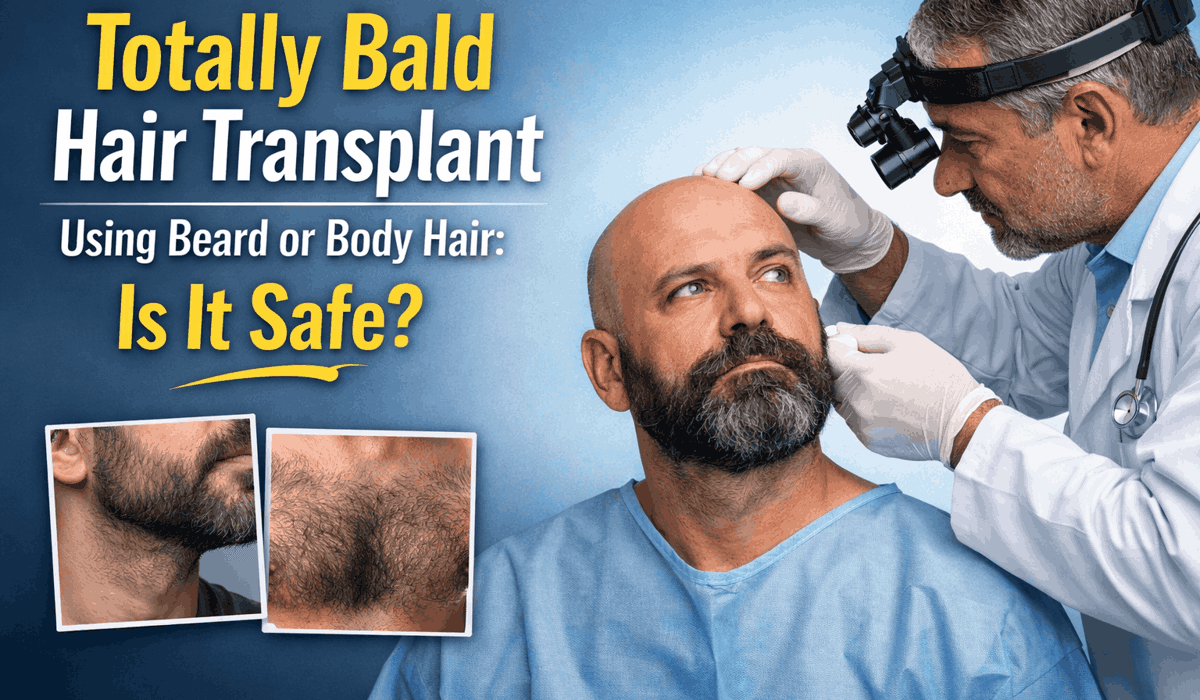
Can You Get a Hair Transplant If You Are Completely Bald? Yes, a hair transplant can be possible even if a person is completely bald, but only when suitable donor hair is available on the beard or body.
The amount of hair on the scalp does not decide eligibility. The quality and stability of donor follicles decide it.
Hair transplant surgery involves relocating living hair follicles from donor areas to bald scalp skin. These follicles retain the biological characteristics of their origin. If donor follicles resist hair loss, they can continue growing after transplantation. This principle applies even in cases of total scalp baldness.
However, this does not mean that every totally bald individual qualifies for surgery. Doctors apply strict medical criteria to determine whether transplantation can provide safe and meaningful results.
What Doctors Mean by “Totally Bald”
In medical practice, the term “totally bald” does not rely only on appearance. Doctors evaluate baldness based on pattern, cause, duration, and donor stability.
A person may appear completely bald due to advanced androgenetic alopecia, long-standing untreated hair loss, scarring alopecia, or previous unsuccessful procedures. Each cause affects transplant planning in a different way.
A bald scalp does not indicate the absence of transplant potential. Doctors focus on whether usable follicles exist elsewhere and whether the scalp can support implanted grafts.
Why Donor Hair Determines Eligibility
Hair transplant surgery depends entirely on donor follicles. These follicles must survive extraction, implantation, and long-term growth. Their resistance to hair loss determines durability.
In fully bald patients, traditional scalp donor areas often show low density or miniaturization. This limits the number of grafts that can be safely harvested. For this reason, doctors assess non-scalp donor sources such as the beard and body.
Donor evaluation includes medical examination under magnification. Surgeons assess follicle count, hair shaft thickness, curl pattern, growth cycle, and skin condition. Strong donor hair can support transplantation even when scalp hair is absent.
Can a Completely Bald Scalp Accept Transplanted Hair?
Yes, a bald scalp can accept transplanted hair. Existing scalp hair does not support graft survival. Blood supply and scalp health support it.
During surgery, doctors create small recipient sites in bald skin. Implanted follicles connect to the local blood supply within days. Hair growth begins after a resting phase that lasts several weeks.
In totally bald patients, doctors plan implantation to improve coverage rather than recreate youthful density. This approach reduces scalp visibility while respecting donor limits.
Medical Criteria Used to Approve Surgery in Totally Bald Patients
Doctors apply strict screening before approving surgery. This screening protects both patient safety and surgical outcome.
Key medical factors include donor stability, scalp condition, and patient expectations.
| Medical Factor | Suitable Finding | Unsuitable Finding |
|---|---|---|
| Donor hair source | Stable beard or body hair | Sparse or weak donor hair |
| Donor density | Moderate to high | Very low |
| Hair shaft type | Thick terminal hair | Thin miniaturized hair |
| Scalp condition | Healthy, flexible skin | Fibrosis or scarring |
| Hair loss activity | Stable | Active inflammatory loss |
| Patient expectation | Coverage improvement | Full density goal |
Only patients who meet most of these criteria proceed to surgical planning.
Why Some Totally Bald People Qualify for Transplantation
Some individuals lose all scalp hair while retaining strong beard or body hair. This occurs because different body regions respond differently to hormonal influence.
Beard hair often remains resistant to androgen-related hair loss. In many men, beard follicles stay thick and stable even when scalp follicles disappear. Certain body hair regions may also retain viable follicles.
This biological variation allows doctors to use non-scalp donor hair to restore scalp coverage in selected patients.
Why Surgery Is Not Advised for Every Fully Bald Patient
Not all totally bald individuals qualify for hair transplantation. Doctors may decline surgery when risks outweigh benefits.
Common reasons include extremely low donor density, weak hair shafts, active autoimmune scalp disorders, poor healing capacity, or unrealistic cosmetic expectations.
In such cases, doctors advise non-surgical options or supportive cosmetic approaches instead of surgery.
Importance of Scalp Health in Advanced Baldness
Scalp health plays a critical role in graft survival. Long-term baldness may reduce scalp blood flow. Some patients also develop scalp tightness or fibrotic changes.
Doctors assess scalp thickness, elasticity, and vascular response before surgery. Poor scalp quality can reduce graft survival even when donor hair remains strong.
This evaluation helps predict outcomes and reduces surgical risk.
Clinical Understanding at This Stage
Complete baldness alone does not rule out hair transplantation. Donor hair quality remains the deciding factor. Beard and body hair may provide donor follicles in selected cases. Strict medical screening protects patient safety and outcome quality.
Understanding Non-Scalp Donor Hair in Totally Bald Hair Transplant
When scalp donor hair becomes insufficient, doctors assess non-scalp donor areas. This situation commonly occurs in totally bald patients. In such cases, beard hair and body hair provide alternative follicle sources. These donor areas follow the same biological rules as scalp hair when transplanted.
Non-scalp donor hair does not replace scalp donor hair in quality. It supplements it. The goal is to increase available grafts while maintaining acceptable cosmetic results. Doctors select these donor sources only after detailed evaluation.
Why Non-Scalp Donor Hair Is Considered
Traditional hair transplant surgery relies on the back and sides of the scalp. In fully bald patients, these areas often show low density or weak follicles. Harvesting too many grafts from these zones can cause visible thinning or scarring.
Non-scalp donor hair becomes relevant when:
- Scalp donor density is very low
- The bald surface area is large
- Coverage improvement matters more than density
- The patient accepts texture variation
Doctors do not automatically choose non-scalp donors. They do so only when medical assessment supports it.
Beard Hair as a Donor Source for the Scalp
Beard hair serves as the most reliable non-scalp donor source in men. Beard follicles often remain thick and stable even in advanced baldness. Their resistance to hair loss makes them suitable for transplantation.
Beard hair differs from scalp hair in several ways. It usually has a thicker shaft. It may grow faster. It often shows a coarser texture. These traits affect where doctors place it on the scalp.
Doctors commonly use beard hair in areas where density matters more than softness. Mid-scalp and crown regions often receive beard grafts. Hairlines usually require careful blending.
Medical Evaluation of Beard Donor Area
Doctors assess the beard donor area with precision. They examine hair density, follicle spacing, skin thickness, and healing tendency. Not every beard qualifies as a donor source.
Key evaluation factors include:
- Beard density per square centimeter
- Hair shaft thickness
- Direction and curl pattern
- Skin elasticity
- Risk of visible donor marks
Harvesting beard hair requires experience. Improper extraction can cause visible patches or pigmentation changes.
Body Hair as a Donor Source
Body hair serves as an additional donor option when beard hair remains insufficient. Doctors may assess chest, abdomen, arms, legs, or back hair depending on availability.
Body hair differs significantly from scalp and beard hair. It usually grows shorter. It has a shorter growth phase. Texture variation remains common.
Because of these differences, doctors use body hair in limited roles. It often supports coverage rather than visual density.
Medical Limitations of Body Hair Transplant
Body hair shows higher variability in growth behavior. Some grafts may grow slowly. Some may stop growing after reaching a short length. These factors affect cosmetic planning.
Doctors usually reserve body hair for:
- Increasing overall graft count
- Filling low-visibility scalp areas
- Supporting existing grafts
Body hair alone rarely provides satisfactory cosmetic coverage for a totally bald scalp.
Comparison of Scalp Hair, Beard Hair, and Body Hair
The table below explains key differences among donor hair types.
| Feature | Scalp Hair | Beard Hair | Body Hair |
|---|---|---|---|
| Shaft thickness | Medium | Thick | Variable |
| Growth length | Long | Medium-long | Short |
| Growth cycle | Long | Moderate | Short |
| Texture | Soft | Coarse | Variable |
| Cosmetic role | Primary | Supportive | Limited support |
| Donor stability | High | High | Variable |
This comparison helps doctors decide how to distribute grafts across the scalp.
How Hair Characteristics Affect Visual Results
Hair characteristics directly affect transplant appearance. Thickness creates visual density. Curl adds coverage. Color contrast affects scalp visibility.
Beard hair provides strong visual coverage due to thickness. However, coarse texture may stand out if placed incorrectly. Body hair provides softer coverage but lacks length.
Doctors mix donor hair types carefully. Strategic placement helps balance texture and appearance.
Donor Area Healing and Recovery
Healing varies by donor site. Scalp donor areas usually heal quickly. Beard donor sites may show redness or pigmentation changes for several weeks. Body donor sites may take longer to settle.
Proper technique reduces visible donor marks. Doctors space extractions evenly. They respect skin characteristics. Aftercare also influences healing.
Patients must follow post-procedure instructions closely. This reduces infection risk and improves healing.
Donor Area Safety Considerations
Non-scalp donor harvesting requires experience. Improper handling can lead to scarring, pigmentation changes, or uneven appearance.
Doctors evaluate:
- Skin sensitivity
- Tendency for keloid formation
- Past healing history
Patients with high scarring risk may not qualify for non-scalp donor harvesting.
Role of Donor Hair Mixing in Totally Bald Patients
In totally bald patients, doctors often mix donor hair types. This approach increases graft availability and improves coverage.
A typical strategy includes:
- Scalp hair for hairline and frontal zones
- Beard hair for mid-scalp and crown
- Body hair for filler support
This layered method improves visual balance while respecting biological limits.
Clinical Understanding at This Stage
Non-scalp donor hair expands surgical options for totally bald patients. Beard hair offers the most reliable alternative. Body hair provides limited support in selected cases. Hair characteristics dictate placement strategy.
Proper donor selection and distribution remain essential for acceptable outcomes.
How Hair Transplant Is Performed in Totally Bald Patients
Hair transplant surgery in totally bald patients requires careful planning. The absence of scalp donor hair changes the surgical approach. Doctors rely on follicular unit extraction to harvest grafts from beard or body areas.
The procedure begins with detailed donor assessment. Doctors calculate the total graft requirement based on scalp surface area and desired coverage. They also decide how to distribute grafts from different donor sources.
During harvesting, doctors extract follicles one by one using small punches. This method reduces visible scarring. It also protects surrounding skin. Harvested grafts are sorted based on thickness and structure.
Implantation follows a planned pattern. Doctors place grafts at specific angles and depths. This step helps achieve natural-looking coverage despite texture differences between donor hair types.
Surgical Planning for Completely Bald Scalp
Surgical planning plays a critical role in totally bald cases. The scalp surface area is large. Donor supply is limited. Doctors must balance these two factors carefully.
Doctors usually avoid high-density packing. Instead, they focus on strategic placement. The goal is to reduce scalp shine and create the illusion of hair presence.
Hairline design remains conservative. Doctors avoid sharp or youthful hairlines. A mature hairline suits donor limitations and improves long-term satisfaction.
Is Beard or Body Hair Transplant Safe?
Beard and body hair transplantation can be safe when performed by trained surgeons. Safety depends on proper patient selection and surgical skill.
Beard donor sites generally heal well. Body donor sites may take longer to settle. Both donor and recipient areas require careful handling to reduce complications.
Safety risks increase when procedures ignore medical limits. Excessive harvesting can cause visible donor marks. Poor implantation technique can reduce graft survival.
Donor Site Risks and Complications
Non-scalp donor harvesting carries specific risks. Doctors discuss these risks before surgery.
Common donor site concerns include:
- Temporary redness
- Swelling
- Mild discomfort
- Pigmentation changes
Less common risks include scarring or uneven donor appearance. These risks increase in patients with sensitive skin or poor healing history.
Proper spacing of extractions reduces these issues. Post-procedure care also plays a key role.
Recipient Site Risks in Totally Bald Patients
Recipient site risks exist in all hair transplant surgeries. Totally bald patients may face additional challenges due to reduced scalp blood flow.
Possible recipient site issues include:
- Prolonged redness
- Delayed graft growth
- Patchy results
- Reduced graft survival
Doctors reduce these risks through careful graft placement and conservative density planning.
Growth Timeline After Beard or Body Hair Transplant
Hair growth after transplantation follows a predictable pattern. Understanding this timeline helps set realistic expectations.
| Time Period | Expected Changes |
|---|---|
| First 2–3 weeks | Graft settling and scab shedding |
| 1–3 months | Temporary hair shedding |
| 3–6 months | Early regrowth begins |
| 6–9 months | Visible coverage improvement |
| 9–12 months | Continued thickening |
| 12–18 months | Final cosmetic outcome |
Beard hair often grows earlier due to its growth cycle. Body hair may show slower or limited growth.
Why Results Differ in Totally Bald Patients
Results in totally bald patients differ from those with partial hair loss. Donor limitations restrict density. Hair texture differences affect appearance.
Beard hair provides strong coverage due to thickness. Body hair adds filler support but lacks length. Mixing donor hair types helps balance these differences.
Doctors aim to create visual coverage rather than full density. This distinction remains essential for patient satisfaction.
Graft Survival Factors in Non-Scalp Transplantation
Several factors affect graft survival in totally bald patients.
Key factors include:
- Donor hair quality
- Handling of grafts
- Time outside the body
- Scalp blood supply
- Post-procedure care
Doctors minimize graft trauma by limiting extraction time and maintaining proper hydration. Patients must follow aftercare instructions closely.
Why Full Density Is Not Achievable in Totally Bald Heads
A totally bald scalp requires a very high number of grafts for full density. Donor areas cannot supply such numbers safely.
For example, a full scalp may require more than 8,000 grafts for dense coverage. Non-scalp donor areas rarely provide such capacity. Attempting high density can exhaust donor supply and increase complications.
Doctors therefore focus on coverage improvement rather than density restoration.
Importance of Patient Counseling Before Surgery
Proper counseling plays a critical role in surgical success. Doctors must explain limitations clearly. Patients must understand realistic outcomes.
Misunderstanding leads to dissatisfaction even when surgery succeeds medically. Clear communication prevents this issue.
Doctors often recommend staged procedures. This approach allows assessment of graft growth before additional sessions.
Clinical Understanding at This Stage
Hair transplant surgery in totally bald patients requires advanced planning. Beard and body hair can provide donor follicles. Safety depends on proper technique and patient selection. Results focus on coverage, not density.
Limitations of Hair Transplant in Fully Bald Patients
Hair transplant surgery in fully bald patients has clear limits. Donor hair supply remains finite. The bald scalp surface area remains large. This imbalance affects achievable results.
Non-scalp donor hair helps increase graft availability. It does not remove donor limits. Beard and body hair cannot fully replace scalp hair in density or texture. Attempting to overharvest donor areas can cause visible thinning or scarring.
Another limitation involves texture mismatch. Beard hair appears coarser than scalp hair. Body hair often grows shorter. Doctors must plan placement carefully to avoid unnatural appearance.
Multiple sessions may be required in some patients. Even then, full density remains unrealistic. Doctors focus on cosmetic coverage and scalp concealment.
Why Multiple Sessions May Be Required
In fully bald cases, donor grafts often need staged use. One session may not provide enough coverage. Doctors may advise a second session after assessing growth.
Staged procedures allow safer donor use. They also help doctors adjust placement based on initial results. However, not all patients qualify for repeat sessions due to donor exhaustion.
Patients must understand that more sessions do not guarantee higher density. Each session still follows donor safety limits.
Cost Factors in Beard and Body Hair Transplant
Hair transplant cost varies widely in fully bald patients. No fixed global pricing exists. Several medical and procedural factors affect cost.
Key cost-influencing factors include:
- Total graft requirement
- Donor hair source
- Number of donor areas used
- Surgical time
- Number of sessions
Beard and body hair harvesting requires more time and precision than scalp harvesting. This increases procedural complexity. As a result, non-scalp donor procedures often cost more than standard scalp transplants.
The table below explains cost variation factors.
| Cost Factor | Effect on Cost |
|---|---|
| High graft requirement | Increases cost |
| Multiple donor areas | Increases cost |
| Multiple sessions | Increases cost |
| Limited donor supply | May limit surgery |
| Advanced surgical planning | Increases cost |
Patients should seek individualized evaluation rather than rely on generic estimates.
Who Should Not Consider Hair Transplant Surgery
Hair transplant surgery does not suit every fully bald individual. Doctors may advise against surgery in certain situations.
Surgery is usually not advised when:
- Donor hair density remains very low
- Hair shafts are weak or miniaturized
- Active autoimmune scalp disease exists
- Healing capacity is poor
- Expectations focus on full density
In such cases, surgery may produce unsatisfactory cosmetic results or medical risk.
Non-Surgical and Supportive Alternatives
When surgery cannot meet expectations, doctors discuss non-surgical options. These options do not involve follicle transfer. They focus on cosmetic improvement.
Common alternatives include:
- Scalp micropigmentation
- Hair systems or prosthetic solutions
- Medical therapy for scalp health
Each option has its own benefits and limits. Selection depends on patient goals, lifestyle, and medical suitability.
Comparison of Alternatives for Fully Bald Individuals
| Option | Purpose | Durability | Maintenance |
|---|---|---|---|
| Scalp micropigmentation | Scalp camouflage | Long-term | Periodic touch-up |
| Hair systems | Immediate coverage | Temporary | Regular upkeep |
| Medical therapy | Scalp condition support | Ongoing | Continuous use |
| Surgery | Hair relocation | Permanent follicles | Minimal |
Doctors may also combine options to improve cosmetic appearance.
How to Make an Informed Medical Decision
Decision-making requires proper medical consultation. Patients should ask clear questions and understand limitations.
Important points to discuss include:
- Donor hair assessment results
- Expected coverage level
- Number of sessions required
- Possible risks
- Long-term maintenance
Written consent and realistic goal setting protect both patient and doctor.
Frequently Asked Questions
Can you get a hair transplant if you are fully bald?
Yes, surgery may be possible if stable donor hair exists on the beard or body. Eligibility depends on donor quality and scalp health.
Is beard hair suitable for scalp transplantation?
Beard hair can work well due to its thickness and stability. Doctors usually place it in mid-scalp or crown areas.
Is body hair transplant permanent?
Transplanted body hair usually remains permanent. Growth length and texture depend on the donor area.
Does beard hair grow like scalp hair?
Beard hair retains its original growth pattern. It may appear thicker and grow differently from scalp hair.
How many grafts are needed for a totally bald head?
The number varies widely. Donor availability often limits graft count more than scalp size.
Are results natural in fully bald patients?
Results focus on coverage, not full density. Proper planning improves natural appearance.
How long does recovery take?
Initial healing occurs within weeks. Visible growth begins after several months.
Can beard and body hair be mixed together?
Yes, doctors often mix donor hair types to improve coverage and balance texture.
Are there risks involved?
Risks include donor site marks, uneven growth, and limited density. Proper technique reduces these risks.
What if I am not a suitable candidate?
Doctors may suggest non-surgical cosmetic options instead of surgery.