FUE vs FUT: Which Is Best for You? A Practical Comparison
- BY Dr. Ajay Patel
- December 21, 2025
- 486 Views
This article is medically reviewed by Dr. Ajay Patel, MD, a Board-Certified Internal Medicine Physician (USA), for accuracy, clinical relevance, and adherence to current medical guidelines.
Choosing between FUE and FUT confuses many people planning a hair transplant. Both techniques work. Both deliver permanent results. But each method suits different needs. The right choice depends on scarring concerns, graft requirements, recovery time, and long-term goals.
If you want minimal visible scarring and faster recovery, FUE often fits better. If you need a high number of grafts in one session and do not mind a linear scar, FUT may be more suitable. This guide explains the real differences so you can decide with clarity.
FUE suits patients who want tiny dot scars and quicker recovery. FUT suits patients who need maximum grafts in one session and accept a linear scar. The best method depends on donor hair quality, baldness level, hairstyle preference, and budget.
What Is the Real Difference Between FUE and FUT?
The main difference lies in how surgeons extract hair follicles from the donor area.
| Factor | FUE (Follicular Unit Extraction) | FUT (Follicular Unit Transplantation) |
|---|---|---|
| Extraction method | Individual follicle removal | Strip of scalp removal |
| Type of scar | Small dot scars | One linear scar |
| Recovery time | Faster | Slightly longer |
| Grafts per session | Moderate to high | High |
| Hair shaving | Often required | Not always required |
Both techniques transplant healthy follicles into thinning or bald areas. The implanted hair grows naturally and permanently.
How FUE Hair Transplant Works
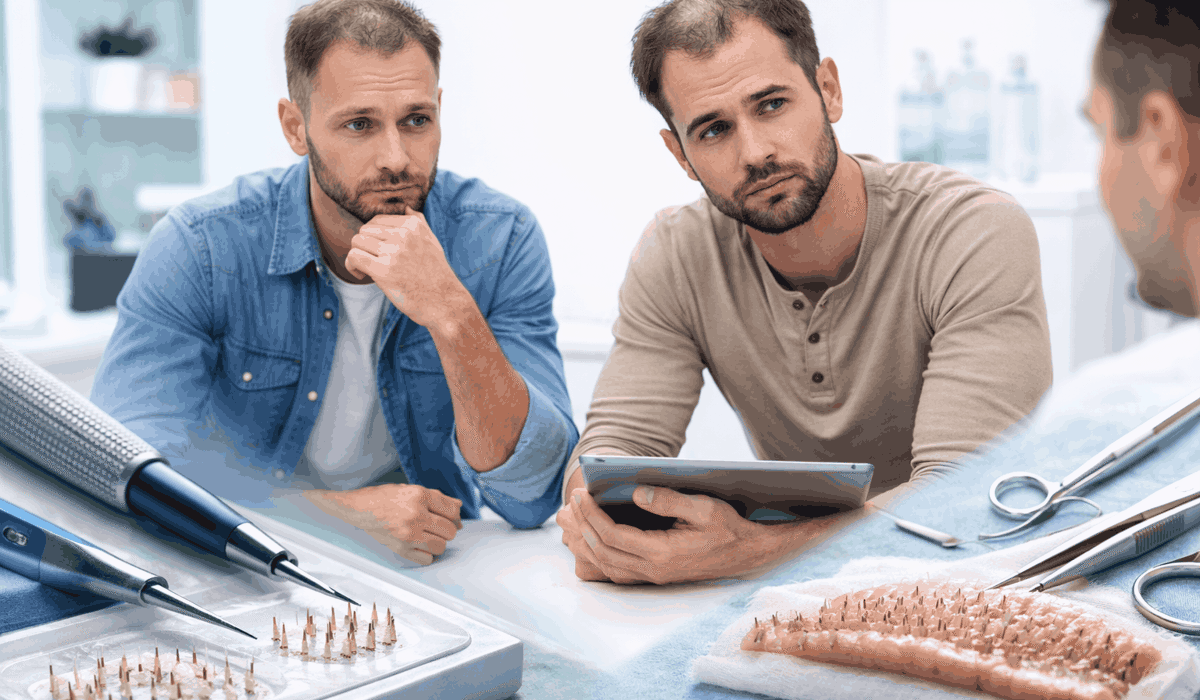
In FUE, the surgeon extracts follicular units one by one from the donor area. The donor area usually sits at the back or sides of the scalp. The surgeon uses a micro-punch tool for extraction.
After extraction, the surgeon prepares recipient sites. Then the surgeon implants the follicles with precise angulation. This approach creates a natural hairline and proper density.
Key Characteristics of FUE
- Leaves tiny circular scars
- Allows short hairstyles after healing
- Offers faster healing and less discomfort
- Enables beard or body hair extraction if needed
- Works well for hairline reconstruction and touch-ups
FUE suits patients who want flexibility in hairstyles. It also suits those who plan multiple sessions over time.
How FUT (Strip Method) Works
In FUT, the surgeon removes a thin strip of scalp from the donor area. The surgeon then closes the donor site with sutures. A trained team dissects the strip under a microscope into individual follicular units.
The surgeon then implants these follicles into the bald areas. This technique preserves follicle quality because it avoids over-harvesting.
Key Characteristics of FUT
- Produces one linear donor scar
- Delivers high graft yield in one session
- Often costs less per graft
- Works well for advanced baldness
- Preserves surrounding donor density
FUT suits patients who keep medium to long hair. It also benefits patients who need extensive coverage in one procedure.
FUE vs FUT: Scarring and Appearance
Scarring concerns influence most decisions. Neither method is scar-free. The scar type differs.
FUE Scarring
FUE leaves small dot scars across the donor area. These scars remain hard to detect once hair grows. Short hairstyles remain possible in most cases.
FUT Scarring
FUT leaves a single linear scar. Hair usually hides it well. Very short hairstyles may expose it. Surgeons often use trichophytic closure to reduce visibility.
| Scarring Aspect | FUE | FUT |
|---|---|---|
| Visibility | Minimal | Moderate |
| Hairstyle flexibility | High | Limited for very short cuts |
| Scar revision options | Easy | Possible but limited |
Recovery, Pain, and Downtime Comparison
Recovery time matters for working professionals. FUE generally offers quicker healing.
FUE Recovery
- Mild swelling for a few days
- Minimal donor discomfort
- Faster return to daily activities
- No stitches to remove
FUT Recovery
- Mild to moderate donor tightness
- Sutures removed after 7–14 days
- Slightly longer downtime
- More post-operative care required
| Recovery Factor | FUE | FUT |
|---|---|---|
| Pain level | Low to moderate | Moderate |
| Downtime | Short | Longer |
| Work resumption | 3–5 days | 7–10 days |
Both procedures require proper aftercare. Following surgeon instructions ensures good graft survival.
Who Should Prefer FUE or FUT?
Choosing the correct technique depends on several factors.
FUE Is Often Better If You:
- Want minimal visible scarring
- Prefer short hairstyles
- Need beard or body hair use
- Plan multiple smaller sessions
- Want faster recovery
FUT Is Often Better If You:
- Need large graft numbers
- Have advanced baldness
- Want maximum donor efficiency
- Accept a linear scar
- Seek lower cost per graft
How Many Grafts Do You Really Need?
Graft requirement plays a major role in choosing between FUE and FUT. The number depends on baldness level, hair characteristics, and coverage goals. Many patients underestimate this factor and regret the decision later.
Surgeons usually assess graft needs using the Norwood scale for men and the Ludwig scale for women. Advanced hair loss requires careful donor planning to avoid depletion.
Typical Graft Requirements by Baldness Level
| Hair Loss Level | Area Covered | Average Grafts Needed |
|---|---|---|
| Norwood 2–3 | Hairline and temples | 1,200–2,000 |
| Norwood 4 | Frontal + mid-scalp | 2,000–3,000 |
| Norwood 5 | Front + mid-scalp | 3,000–4,000 |
| Norwood 6–7 | Extensive baldness | 4,500–6,000+ |
FUT often delivers higher graft counts in one session. FUE usually requires multiple sessions for advanced baldness.
Graft Yield: FUE vs FUT
FUT preserves follicle integrity during extraction. It allows the surgical team to dissect grafts under a microscope. This process reduces transection and improves yield.
FUE extracts follicles individually. Yield depends heavily on surgeon skill, punch size, and donor density.
| Factor | FUE | FUT |
|---|---|---|
| Single-session grafts | Moderate to high | High |
| Follicle damage risk | Slightly higher | Lower |
| Donor area efficiency | Moderate | High |
| Suitability for large sessions | Limited | Excellent |
Patients with dense donor hair may achieve excellent results with either method. Patients with limited donor supply benefit more from FUT.
Cost Comparison: FUE vs FUT
Cost remains a major deciding factor. Pricing varies by clinic, city, surgeon experience, and graft count. Clinics usually charge per graft or per session.
Average Hair Transplant Cost by Country (FUE vs FUT)
Costs vary by clinic reputation, surgeon experience, city, graft count, and technology used.
| Country | FUE Cost per Graft | FUT Cost per Graft | Average Total Session Cost |
|---|---|---|---|
| USA | $5 – $10 | $4 – $8 | $8,000 – $20,000+ |
| United Kingdom | £3 – £7 | £3 – £6 | £6,000 – £15,000 |
| Australia | AUD 6 – 10 | AUD 5 – 8 | AUD 7,000 – 18,000 |
| Canada | CAD 5 – 9 | CAD 4 – 7 | CAD 7,000 – 16,000 |
| Germany | €4 – €8 | €3 – €6 | €6,000 – 14,000 |
| France | €4 – €7 | €3 – €6 | €5,500 – 13,000 |
| Italy | €3 – €6 | €3 – €5 | €5,000 – 12,000 |
| Spain | €3 – €6 | €2.5 – €5 | €4,500 – 11,000 |
| Turkey | €1 – €2.5 | €1 – €2 | €2,000 – 4,500 |
| UAE (Dubai) | $4 – $7 | $3 – $6 | $6,000 – 14,000 |
| South Korea | $3 – $6 | $2.5 – $5 | $5,000 – 12,000 |
| Japan | ¥800 – ¥1,500 | ¥700 – ¥1,200 | ¥1,000,000 – 2,500,000 |
FUE usually costs more per graft. The process takes longer and requires specialized tools. FUT offers better value for large graft numbers.
Lower cost should never guide the decision alone. Poor technique causes permanent donor damage.
Is FUE or FUT Better for Advanced Baldness?
Advanced baldness requires strategic planning. Many patients focus only on hairline restoration. They ignore crown coverage and future hair loss.
FUT works well for advanced stages. It provides a high number of grafts while preserving donor strength. Surgeons often combine FUT with later FUE sessions to refine density.
FUE alone may struggle to provide enough grafts in one sitting. Overharvesting can thin the donor area permanently.
Technique Selection for Advanced Hair Loss
| Baldness Stage | Preferred Approach |
|---|---|
| Norwood 3–4 | FUE or FUT |
| Norwood 5 | FUT or combined |
| Norwood 6–7 | FUT first, FUE later |
Long-term planning prevents unnatural results and donor exhaustion.
Beard and Body Hair: Where FUE Has an Advantage
FUE allows extraction from beard, chest, and other body areas. FUT cannot use non-scalp donor hair. This feature makes FUE valuable in repair cases and severe baldness.
Beard hair offers strong thickness. Surgeons often use it for crown or mid-scalp coverage. Body hair requires careful blending due to growth cycle differences.
| Donor Source | Usable With FUE | Usable With FUT |
|---|---|---|
| Scalp | Yes | Yes |
| Beard | Yes | No |
| Chest | Yes | No |
| Arms/legs | Yes | No |
Only experienced surgeons should perform body hair extraction. Poor planning creates unnatural texture.
Special Considerations for Women
Women usually prefer minimal shaving. FUT allows hair transplantation without shaving the entire donor area. This advantage makes FUT attractive for female patients.
FUE still works for women. Surgeons may use unshaven or partially shaved FUE techniques. These methods take longer and cost more.
Women with diffuse thinning need careful evaluation. Transplanting into unstable hair causes shock loss.
Afro and Curly Hair Patients
Curly and Afro-textured hair grows beneath the scalp in a curved pattern. FUE requires high expertise to avoid follicle damage. FUT often works better in such cases because microscopic dissection preserves curl integrity.
Surgeon experience matters more than technique choice for Afro hair.
Risks and Complications You Should Know
Both procedures are safe when performed correctly. Complications remain rare but possible.
Common Risks
- Infection
- Swelling
- Temporary numbness
- Shock loss
- Poor growth due to mishandling
FUT may cause donor tightness. FUE may thin the donor area if overharvested.
Choosing a qualified surgeon reduces risk significantly.
Timeline: When Will You See Results?
Hair growth follows the same cycle for both techniques.
| Time After Surgery | What Happens |
|---|---|
| 0–2 weeks | Scabbing and healing |
| 2–8 weeks | Shock loss phase |
| 3–4 months | Early regrowth |
| 6–9 months | Visible density |
| 12 months | Final results |
Patience plays a critical role. Early judgment leads to unnecessary worry.
Result Quality: Density, Natural Look, and Longevity
Patients care most about results. They want density, natural hairline and want hair that lasts. Both FUE and FUT can deliver excellent outcomes when a skilled surgeon performs the procedure.
Result quality depends more on planning and execution than on the technique alone. Poor angulation, incorrect graft placement, or weak donor management leads to unnatural outcomes.
Density Comparison
FUT often provides higher density in one session. It preserves follicle quality through microscopic dissection. This advantage helps patients with advanced baldness.
FUE provides good density but spreads graft harvesting across the donor area. Multiple sessions may be required to reach similar coverage.
| Result Factor | FUE | FUT |
|---|---|---|
| Initial density | Moderate to high | High |
| Natural hairline | Excellent | Excellent |
| Longevity | Permanent | Permanent |
| Suitability for touch-ups | Excellent | Limited |
Hair transplanted using either method grows for life. The donor hair remains resistant to pattern baldness.
Hairline Design: Where Skill Matters Most
Hairline design defines the success of a transplant. An aggressive hairline may look good early but fails with age. A conservative design preserves future options.
Surgeons design hairlines based on facial structure, age, and future hair loss risk. They use single-hair grafts at the front and thicker grafts behind.
FUE allows finer placement for detailed hairline work. FUT also delivers excellent hairlines when the surgeon handles grafts properly.
Technique never replaces artistry.
Before and After Results: What to Evaluate
Before-and-after photos influence patient decisions. Many clinics use misleading images. Patients must evaluate results carefully.
What to Check in Photos
- Same lighting and camera angle
- Similar hair length
- Clear donor area visibility
- Time gap of at least 9–12 months
- No styling products masking density
Look for consistency across multiple patients. One good case does not prove expertise.
Revision and Repair Cases
Repair cases require advanced skills. These cases involve pluggy hairlines, poor density, or donor damage.
FUE plays a major role in repair work. Surgeons use it to soften hairlines, camouflage scars, and redistribute grafts.
FUT repair remains possible but limited. Scar tissue restricts strip harvesting.
| Repair Scenario | Preferred Technique |
|---|---|
| Pluggy hairline | FUE |
| Donor scar camouflage | FUE |
| Poor density correction | FUE |
| Large failed transplant | Combined |
Repair procedures cost more and take longer. Proper planning prevents the need for revision.
Surgeon Selection: The Most Important Decision
The surgeon determines success more than the technique. Even the best method fails in inexperienced hands.
Patients should evaluate the surgeon, not the clinic brand.
What to Look for in a Surgeon
- Direct involvement in extraction and implantation
- Consistent long-term results
- Transparent graft planning
- Clear explanation of limitations
- Ethical hairline design
Avoid clinics that delegate surgery entirely to technicians. Avoid promises of unrealistic density.
Clinic Red Flags You Should Avoid
Some clinics focus on volume, not quality. These centers often damage donor areas permanently.
Major Warning Signs
- Guaranteed results
- Extremely low pricing
- No donor assessment
- Pressure sales tactics
- Lack of medical registration
A hair transplant is irreversible. One poor decision causes lifelong regret.
FUE vs FUT: Long-Term Planning Matters
Hair loss continues even after transplantation. Surgeons must plan for future thinning.
FUT preserves donor density for future use. FUE spreads extraction across a wider area. Overuse causes visible thinning.
Younger patients must plan conservatively. A mature hairline often delivers better long-term satisfaction.
Balanced planning protects both appearance and donor supply.
Decision Checklist: Which One Fits You Better?
Use this checklist before deciding.
Choose FUE if you:
- Prefer short hairstyles
- Want minimal visible scarring
- Need beard or body hair use
- Plan staged procedures
- Want faster recovery
Choose FUT if you:
- Need maximum grafts
- Have advanced baldness
- Want lower cost per graft
- Keep medium or long hair
- Have strong donor density
Some patients benefit from a combined approach. Surgeons may start with FUT and refine with FUE later.
Final Thought Before You Decide
FUE and FUT both work. Neither is universally superior. The correct choice aligns with your hair loss pattern, donor capacity, and long-term goals.
Do not rush the decision. Get a detailed donor analysis. Ask for realistic graft estimates. Evaluate surgeon experience carefully.
A well-planned transplant restores hair and confidence. A poorly planned one creates permanent damage.
Frequently Asked Questions
1. Is FUE better than FUT?
FUE is not always better. FUE suits patients who want minimal visible scarring and faster recovery. FUT suits patients who need more grafts in one session. The best option depends on individual goals.
2. Which hair transplant method is less painful?
FUE usually causes less post-operative pain. FUT may cause donor tightness due to sutures. Both procedures use local anesthesia and remain well tolerated.
3. Does FUE leave any scar?
Yes. FUE leaves tiny dot scars in the donor area. These scars are usually hard to notice once hair grows. FUE is not a scar-free procedure.
4. Will FUT leave a permanent scar?
Yes. FUT leaves a linear scar at the donor site. Hair usually hides it well. Very short hairstyles may reveal the scar.
5. How long does recovery take after FUE vs FUT?
FUE recovery is faster. Most patients return to work within 3–5 days. FUT recovery takes longer due to stitches, often 7–10 days.
6. Which method gives more grafts in one session?
FUT usually provides more grafts in a single session. This advantage helps patients with advanced baldness who need extensive coverage.
7. Can FUE use beard or body hair?
Yes. FUE allows extraction from beard and body areas. FUT cannot use non-scalp donor hair.
8. Is FUE or FUT better for advanced baldness?
FUT works better for advanced baldness due to higher graft yield. Surgeons may combine FUT with FUE for optimal long-term results.
9. How long do hair transplant results last?
Hair transplanted using FUE or FUT lasts permanently. The transplanted follicles resist pattern hair loss and continue growing for life.
10. How do I choose the right surgeon?
Choose a surgeon with proven long-term results. Look for transparent planning, ethical hairline design, and direct surgeon involvement during surgery.
Ready for the Next Step?
If you are considering a hair transplant, start with a professional donor analysis. Ask for realistic graft numbers. Discuss future hair loss risks. Choose the method that fits your long-term plan, not short-term marketing claims.